Our Science
Reference-Free Sequencing : Recovering an Antibody Sequence from the Protein
- Reference-free antibody sequencing determines the amino acid sequence of a monoclonal antibody (mAb) from the purified protein, without any prior sequence of that antibody.
- The method applies when the sequence is missing: a lost or unstable hybridoma line, a legacy antibody transferred without records, or a biosimilar program where the originator sequence is undisclosed.
- Multi-enzyme digestion produces overlapping peptides; nano-LC-MS/MS with higher-energy collisional dissociation (HCD) generates b and y ion series; electron-transfer/higher-energy collision dissociation (EThcD) adds complementary c and z ions.
- At CovalX, de novo sequencing of a mAb takes 1 to 2 weeks from sample receipt and requires 100 µg of purified antibody.
When a monoclonal antibody (mAb) has no documented sequence, reference-free sequencing reconstructs the complete amino acid directly from MS/MS fragment ion data, without any prior sequence of the target antibody. The only input is the purified protein. Current workflows combine multi-enzyme digestion, high-resolution nano-flow liquid chromatography coupled to tandem mass spectrometry (nano-LC-MS/MS), and complementary fragmentation modes to deliver full heavy and light chain sequences within 1 to 2 weeks.
Why do monoclonal antibody programs lose their reference sequence?
Monoclonal antibody programs lose their reference sequence through cell line failure, incomplete asset transfer, or deliberate non-disclosure. Each case leaves a usable protein with no documented sequence.
In all these situations, monoclonal antibody sequencing starts from the protein itself.
What does reference-free antibody sequencing mean?
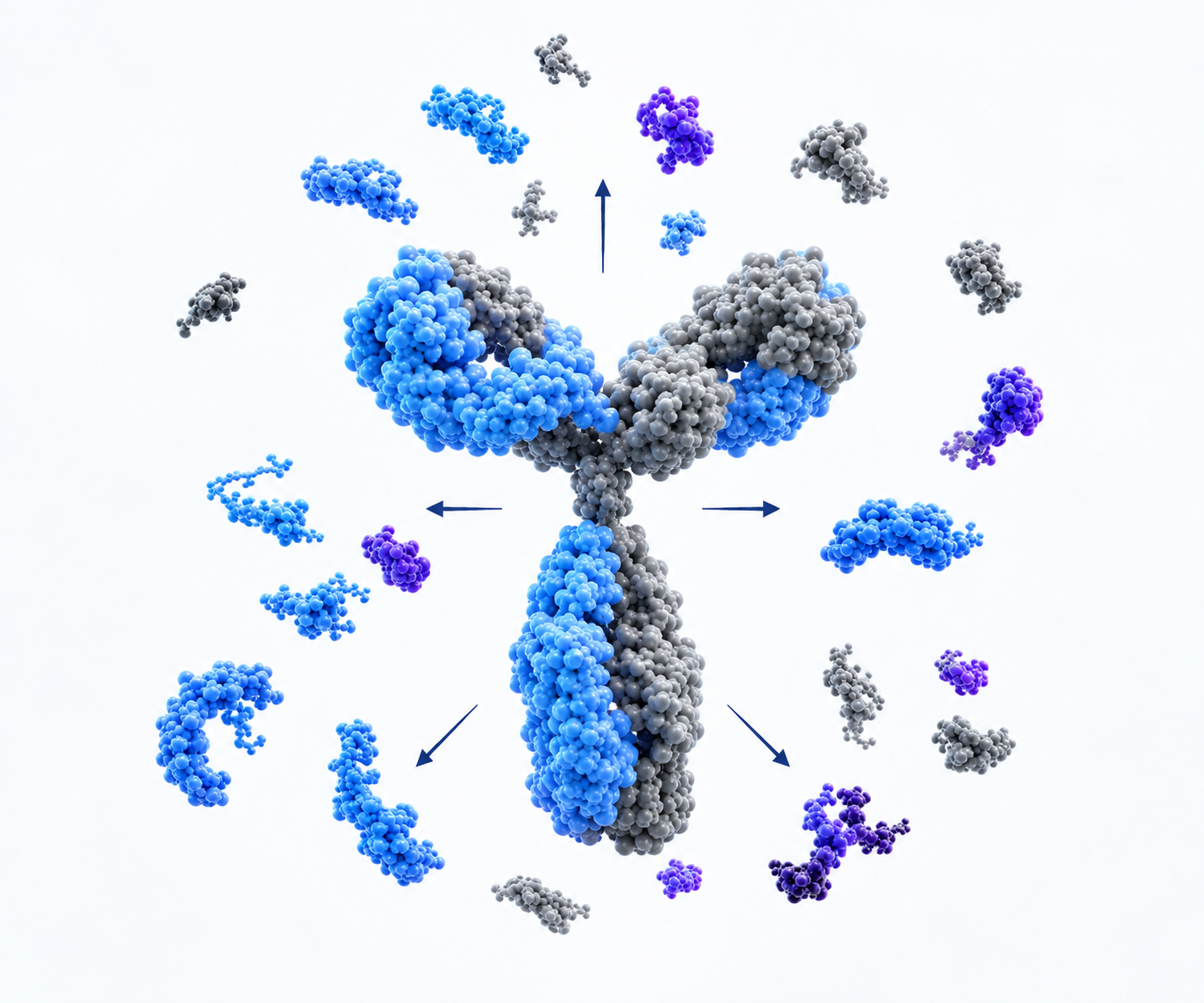
Reference free antibody sequencing, or de novo antibody sequencing, determines the amino acid sequence of an antibody without requiring a prior sequence of that antibody. The missing reference is the target sequence itself. Germline databases and internal sequence libraries can still support peptide assembly.
 De Novo Sequencing Antibody De novo sequencing
How does de novo sequencing differ from database search?
In protein mass spectrometry, peptide identification follows two approaches: database search, which compares spectra to theoretical spectra of known proteins, and de novo sequencing, which assigns the sequence from the fragment ions themselves.
The distinction matters for antibodies because the variable regions, and the complementarity-determining regions (CDRs) in particular, are generated by somatic recombination and hypermutation. A database search can return the closest germline match, but it cannot report residues that are absent from the database.
What does reference-free antibody sequencing mean?
Reference free antibody sequencing, or de novo antibody sequencing, determines the amino acid sequence of an antibody without requiring a prior sequence of that antibody. The missing reference is the target sequence itself. Germline databases and internal sequence libraries can still support peptide assembly.
How does de novo sequencing differ from database search?
In protein mass spectrometry, peptide identification follows two approaches: database search, which compares spectra to theoretical spectra of known proteins, and de novo sequencing, which assigns the sequence from the fragment ions themselves.
The distinction matters for antibodies because the variable regions, and the complementarity-determining regions (CDRs) in particular, are generated by somatic recombination and hypermutation. A database search can return the closest germline match, but it cannot report residues that are absent from the database.
How does reference-free antibody sequencing work by mass spectrometry?
Reference-free antibody sequencing by mass spectrometry digests the antibody into peptides, fragments each peptide in the instrument, reads the amino acid sequence from the fragment ion masses, and assembles the peptides into full heavy and light chains. The workflow runs in five steps:
- Purification or concentration of the sample, if needed.
- Parallel digestion with several proteolytic enzymes.
- Peptide separation by nano-flow liquid chromatography.
- Tandem mass spectrometry with HCD and EThcD fragmentation.
- Spectrum interpretation and sequence assembly by experts.
Why digest with several enzymes?
Multi-enzyme digestion produces overlapping peptide sets that cover the full antibody sequence. Each enzyme cleaves at different residues, so a cleavage site in one digest falls inside a peptide in another. These overlaps are what allow peptides to be ordered and joined across cleavage sites. The combined peptide sets target 100% sequence coverage.
How do fragment ions encode the sequence?
Higher-energy collisional dissociation (HCD) breaks peptide backbone bonds and produces two complementary ion series: b ions, which retain the N-terminus, and y ions, which retain the C-terminus. The mass difference between two consecutive ions in a series equals the mass of one amino acid residue, so reading the ladder of mass differences gives the sequence. For a given cleavage, the b and y ion masses sum to the peptide mass plus 2 Da.
How does EThcD distinguish leucine from isoleucine?
Leucine and isoleucine have identical masses, so HCD spectra alone cannot tell them apart. Electron-transfer/higher-energy collision dissociation (EThcD) adds a second fragmentation step that cleaves amino acid side chains and produces fragment ions specific to each isomer. In an antibody, a single leucine-to-isoleucine error in a CDR can change binding, so the workflow includes this fragmentation step.
How are peptides assembled into full chains?
Dedicated de novo software reads the sequence of each peptide from the mass differences between consecutive fragment ions. It then aligns the overlapping peptide sequences across all enzyme digests to reconstruct continuous heavy and light chain sequences. At CovalX, client sequence data never enters a public database. The output is the full amino acid sequence, with the position of each CDR. Post-translational modifications (PTMs) detected at the peptide level, such as deamidation, oxidation, and pyroglutamate formation, are reported with their exact position on the sequence.
What are the limits of de novo antibody sequencing by mass spectrometry?
De novo antibody sequencing by mass spectrometry is limited by residues of identical or near-identical mass, by sample purity, and by post-translational modifications.
Sample purity. De novo sequencing assumes the sample contains a single antibody. A mixture of antibodies, or a hybridoma product containing additional chains, complicates assembly because peptides from different chains overlap in mass and sequence.
Post-translational modifications. Deamidation converts asparagine to aspartate or isoaspartate (+0.984 Da) in the sample or during preparation, so an Asn can be read as Asp. Oxidized methionine (147.035 Da) sits 0.033 Da from phenylalanine, which requires high mass accuracy to separate. N-terminal pyroglutamate forms from both Gln and Glu with the same final mass, leaving the first residue ambiguous. Fc glycosylation sits at a conserved site (Asn297). Variable-domain glycosylation occurs in about 15 to 25% of serum IgG; PNGase F removes the glycan and converts that Asn to Asp, and the Asn-X-Ser/Thr sequon is used to assign it back.
Do you have a project waiting?
Sequence your protein of interest
De novo antibody sequencing at CovalX
CovalX provides de novo antibody sequencing as part of its mass spectrometry CRO services. The workflow combines parallel multi-enzyme digestion, nano-flow LC-MS/MS, HCD fragmentation, and EThcD for leucine and isoleucine assignment. Dedicated de novo software aligns the overlapping peptides from all digests to reconstruct the full sequence. Projects require 100 µg of purified antibody, and the sequence is delivered 1 to 2 weeks after sample receipt. The CovalX de novo sequencing service page details sample requirements and the project workflow. Once the sequence is known, Ab characterization at CovalX covers the follow-on analytical work.
Frequently asked questions
What is the difference between de novo antibody sequencing and hybridoma sequencing?
Hybridoma sequencing reads the nucleotide sequences transcribed by a living cell line, while de novo antibody sequencing reads the amino acid sequence of the secreted protein by mass spectrometry. Hybridoma sequencing requires viable cells. De novo sequencing only requires the purified protein.
How much of the antibody sequence does de novo sequencing cover?
De novo sequencing with multi-enzyme digestion targets 100% coverage of the heavy and light chains, including the variable domains, the CDRs, and the constant regions. Overlapping peptides from several enzymes allow each region to be confirmed by more than one peptide.
Can mass spectrometry distinguish leucine from isoleucine?
Yes, mass spectrometry can distinguish leucine from isoleucine. While they have the same elemental composition and the same mass (113.08406 Da), mass spectrometry can distinguish them by fragmenting the side chain. With EThcD, z ions produce w ions that differ by isomer: a loss of 43 Da indicates leucine, and a loss of 29 Da indicates isoleucine. This matters in antibody de novo sequencing, where an L/I swap in a CDR can change antigen binding.
How long does reference-free de novo sequencing of a monoclonal antibody take?
At CovalX, de novo sequencing of a monoclonal antibody takes 1 to 2 weeks from sample receipt.
What quantity & level of purity is needed?
For reference-free sequencing, CovalX ask for 100µg of antibody, and 95% purity.