Our Science
De Novo Sequencing by Mass Spectrometry: Determining a Sequence Without a Reference
- De novo protein sequencing reconstructs the complete amino acid sequence of a protein directly from mass spectrometry data, without a reference database or genome.
- It is the method to use when no reference sequence exists: antibodies from lost or undocumented hybridomas, new purified proteins and proteins from poorly sequenced organisms.
- The workflow combines parallel multi-enzyme digestion, nano-flow LC-MS/MS, and dual fragmentation (HCD and EThcD) to read the sequence from the fragment ions of overlapping peptides.
- A CovalX project returns the full amino acid sequence, a post-translational modification and glycan profile, each mapped to position.
An antibody can reach the lab with no sequence on file: an hybridoma line lost or drifted, an in-licensed asset transferred without records… The protein exists but the reference does not, and database-dependent identification has nothing to match against.
De novo protein sequencing reconstructs the complete amino acid sequence directly from tandem mass spectrometry (MS/MS) fragment ion data, without a reference database or genome. The only input is the purified protein.
This article explains what de novo protein sequencing determines, how mass spectrometry reads a sequence from fragment ions, and what a CovalX project delivers.
 De Novo Sequencing Antibody De novo sequencing
 What is de novo protein sequencing, and when do you need it?
De novo protein sequencing determines the amino acid sequence of a protein directly from mass spectrometry data, without matching it against a known sequence in a database. The term “de novo” means from the beginning: the sequence is built from the raw fragment signal, rather than confirmed against a candidate already on record.
You need it whenever the reference does not exist. Common cases:
- Monoclonal antibodies from hybridomas with no documented sequence, including lines that were lost, contaminated, or have drifted.
- Legacy or in-licensed assets that changed hands without complete sequence records.
- New purified proteins, when you need certainty.
- Proteins from organisms with no well-annotated reference genome, mutated variants, and sequences held as confidential.
A defined protein sequence supports several development decisions. It grounds intellectual property, since a patent claim on a protein rests on its exact sequence. It confirms primary structure during characterization.
How is de novo sequencing different from a database search?
De novo sequencing reads the amino acid sequence from the fragment ions themselves. A database search takes the opposite route: it identifies a protein by matching its spectra against sequences already stored in a reference database, and it returns a result only when the sequence, or a close relative, is already on record. De novo sequencing needs no prior entry, which is why it applies to proteins that no database contains. It also resolves cases where classical Edman degradation stalls, such as proteins with a blocked N-terminus.
Related reading: Reference-free sequencing
How does mass spectrometry sequence a protein de novo?
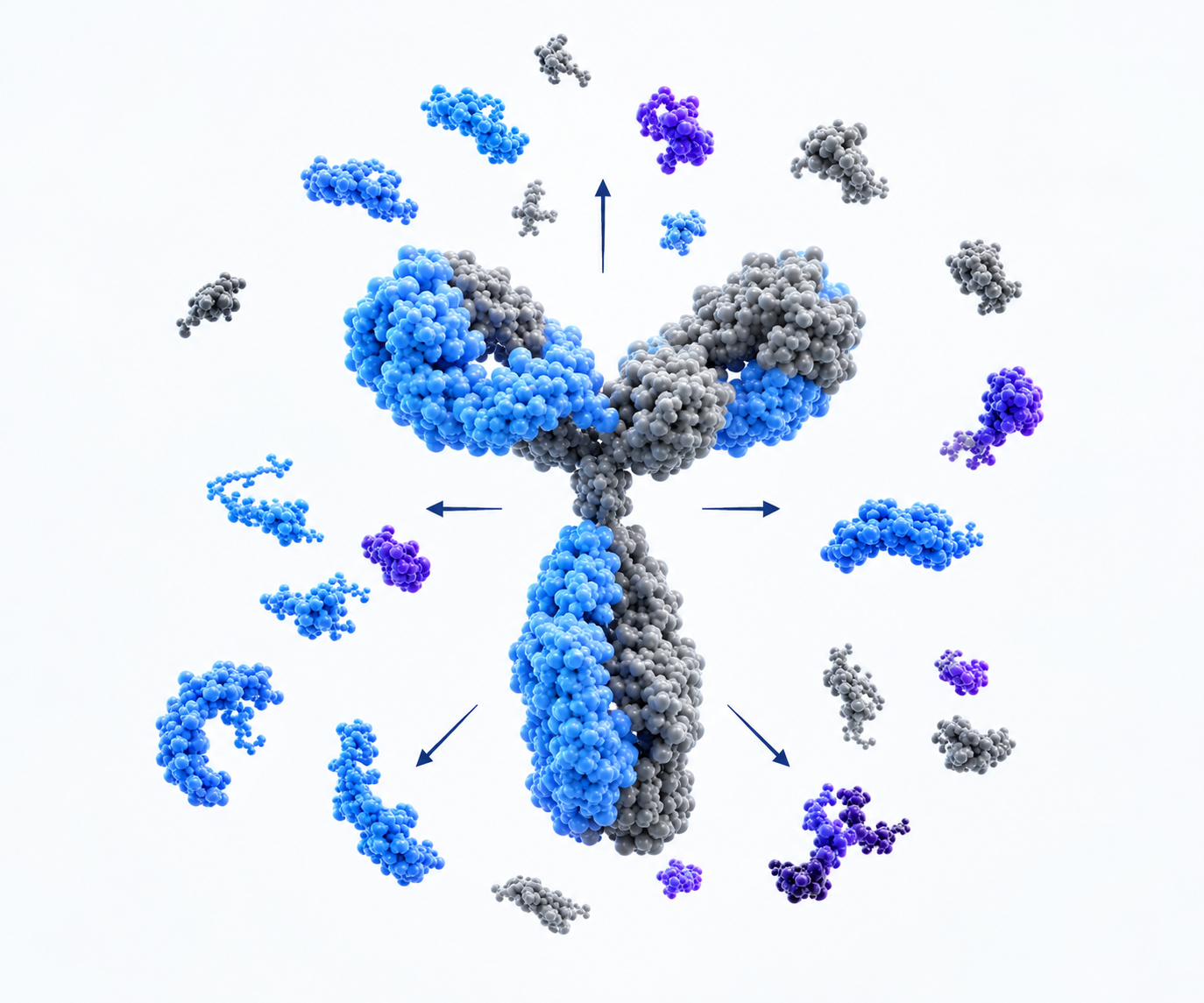
Mass spectrometry sequences a protein de novo by analysing each peptides generated by proteolysis, fragmenting them, and reading the sequence from the mass differences between consecutive fragment ions. Each cleavage of the peptide backbone produces a fragment ion, and the mass gap between two consecutive ions in a series equals the mass of one amino acid residue. Reading the full ladder returns the sequence of that peptide, and assembling the peptides from several proteolytic cleavages returns the full-length sequence of the protein.
Antibody de novo sequencing
Most de novo sequencing projects are monoclonal antibodies, because antibodies routinely reach development with no usable sequence record. The workflow reconstructs both the heavy and light chains from the overlapping peptides of all digests. The complementarity-determining regions (CDRs) are the part most often needed and the hardest to cover, since they vary from one antibody to the next; parallel multi-enzyme digestion is what secures peptide coverage across them. For programs that also need subunit or intact-level analysis alongside the sequence, the CovalX antibody characterization service covers those measurements.
High-Mass MALDI: Our QC step
Before any project, High-Mass MALDI mass spectrometry confirm the integrity of the protein. It measures its the molecular weight up to 2 megadalton, using detection technology CovalX developed.
De novo sequencing follows only once the proteins and complexes pass this check. Sequencing a validated sample is one reason CovalX analyses reach a high success rate. A sequence obtained from a sample that does not represent the intended protein describes a different species, and that result cannot be traced back to the target you set out to characterize. Confirming integrity first removes that risk before any sequencing work starts.
Related reading: High-Mass MALDI service page
What proteins can be sequenced de novo?
De novo sequencing applies to any purified protein, whatever its origin, because the readout depends on the fragment ions of its peptides rather than on a known template. Most CovalX de novo projects are monoclonal antibodies, but the same workflow covers IgMs, antibody fragments, unknown purified proteins, proteins from poorly sequenced organisms, mutated variants, and confidential sequences. Format does not limit the method; sample purity and quantity guide how the workflow is set up.
WANT TO KNOW MORE?
Request a meeting with our team
Work with CovalX
CovalX provides de novo protein sequencing through multi-enzyme digestion, nano-flow LC-MS/MS, and dual fragmentation (HCD and EThcD), returning the full sequence with PTM and glycan profiles. For antibody programs that need subunit or intact-level analysis alongside the sequence, the CovalX antibody characterization service covers those measurements.
Discuss your de novo sequencing project with our team, and we will propose an approach built for your protein.
Frequently asked questions
What does “de novo” mean in protein sequencing?
De novo means new, from the beginning. In sequencing, the amino acid sequence is read directly from the mass spectrometry signal, without a reference sequence to compare against. This is what separates it from database-dependent identification.
When is de novo sequencing needed instead of a database search?
De novo sequencing is needed whenever no reference sequence exists to search against. This includes antibodies from undocumented or lost hybridomas, in-licensed legacy assets without records, and proteins from organisms with no annotated genome.
How does CovalX resolve isobaric amino acids such as leucine and isoleucine?
CovalX applies two fragmentation methods to the same peptides: HCD, which produces b and y ions, and EThcD, which adds complementary c and z ions. The combined fragment data resolve most isobaric ambiguities. Leucine versus isoleucine remains a recognized limit in de novo sequencing, and dual fragmentation is used to reduce it.
Can de novo sequencing data be used in regulatory submissions?
Amino acid sequence determination is an expected element of physicochemical characterization for a biotherapeutic under ICH Q6B, and both the FDA and the EMA accept mass spectrometry sequence data as structural evidence.