Differential Scanning Calorimetry
Talk to Our Scientists
"*" indicates required fields
Differential Scanning Calorimetry (DSC)
Thermal stability is one of the earliest decision points in biotherapeutic development, and one of the most consequential. Candidates that appear equivalent by sequence or binding affinity can differ significantly in conformational stability, aggregation propensity, and formulation tolerance. Without thermodynamic data, that differentiation happens late, often after significant investment in leads that will not survive manufacturing or storage conditions.
Label-free thermodynamic characterization of protein stability.
DSC provides that data early. By measuring the heat absorbed during thermal unfolding, a single experiment resolves Tm, ΔH, and unfolding cooperativity across all structural transitions simultaneously, directly in solution, without labeling or chemical modification of the sample.
How DSC works

Two solution-filled cells (a sample and a buffer reference) are heated at a constant scan rate within the same calorimetric chamber. When the protein unfolds, it absorbs heat. The instrument detects the differential power required to maintain both cells at the same temperature, and converts that signal into an excess heat capacity profile as a function of temperature.
Multiple thermal events within the same sample are resolved as distinct transitions, providing a thermodynamic fingerprint of the molecule in its formulation environment.
Key parameters extracted from each experiment :
| Parameter | Definition |
| Tm | Thermal transition midpoint. Temperature at which 50% of the protein is unfolded. |
| Tonset | Onset of unfolding. |
| ΔH | Enthalpy of unfolding. Reflects the total energy of the transition. |
| T½ | Width of the transition at half-peak height. Reflects structural compactness and cooperativity. |
Applications
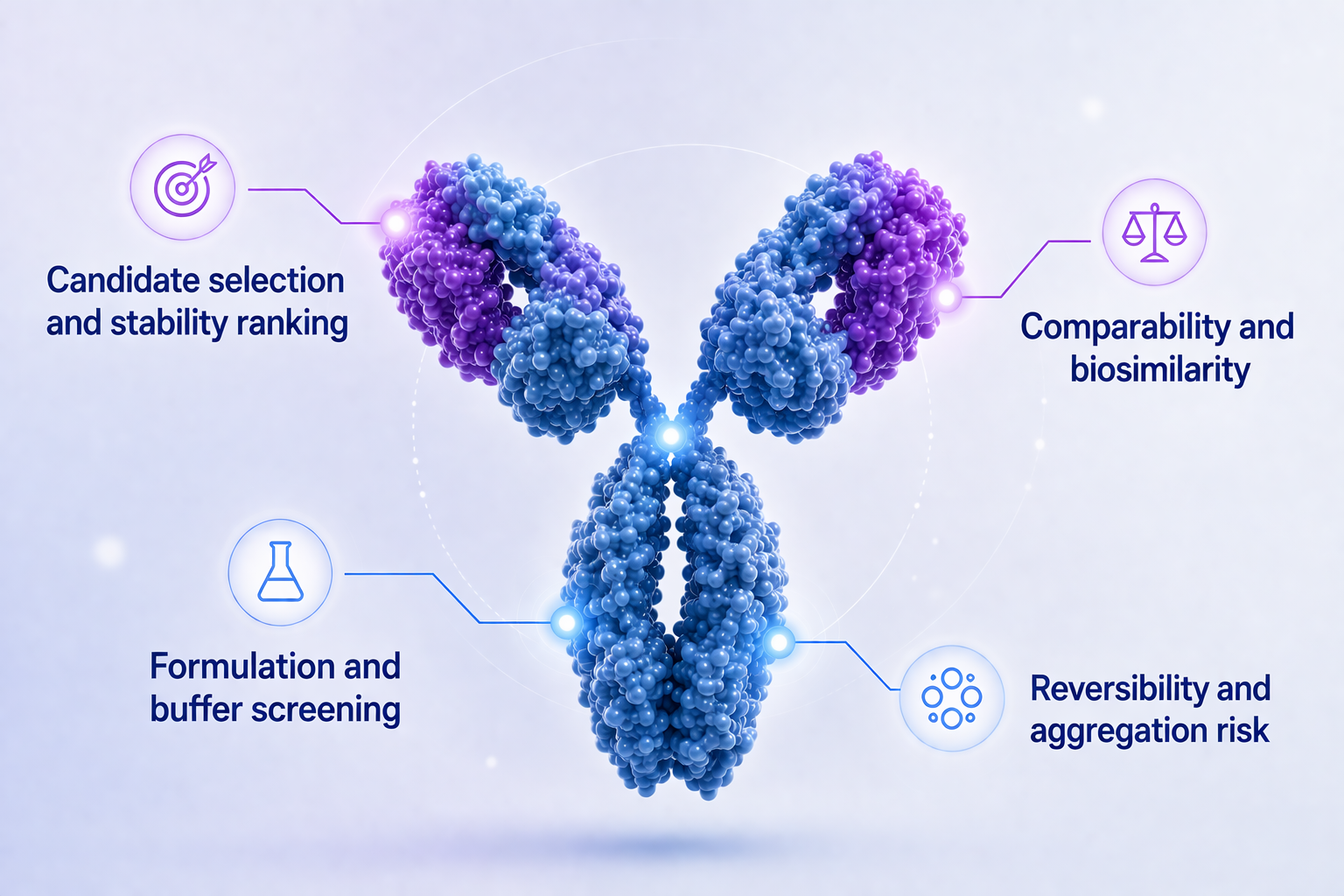
Candidate selection and stability ranking
Compare Tm values quantitatively across protein variants, constructs, or production batches. Candidates that appear equivalent by binding affinity or SDS-PAGE may differ significantly in conformational stability; DSC resolves that difference early, before investment in leads that will not survive manufacturing or storage conditions.
Comparability and biosimilarity
Thermodynamic profiling provides a sensitive fingerprint for detecting changes introduced by process modifications, manufacturing scale-up, or formulation changes. DSC thermograms are accepted as supporting evidence in ICH Q5E comparability packages and biosimilar regulatory submissions (FDA, EMA).
Formulation and buffer screening
Systematic evaluation of pH, ionic strength, and excipient conditions to identify the formulation space that maximizes conformational stability. DSC is a primary method for liquid formulation development at the pre-IND stage.
Reversibility and aggregation risk
Rescan experiments assess whether unfolding is reversible or irreversible. Irreversible transitions are a direct indicator of aggregation propensity. Flagging high-risk candidates early reduces attrition downstream.
Technical Notes
CovalX operates a heat-flux DSC platform. Key analytical features:
- No labeling, no optical probes required.
- Compatible with turbid solutions and complex formulation buffers.
- Suitable for protein concentrations in the low mg/mL range.
- Multi-domain transitions resolved within a single thermogram.
- Buffer-matched reference mandatory for baseline subtraction.
Sample requirements and buffer compatibility are discussed with clients at project setup. DTT-containing buffers and samples with significant bubble formation should be avoided.
Regulatory Context
DSC is recognized under ICH Q6B as a method for physicochemical characterization of biotherapeutics (secondary structure, thermal stability). Tm data generated by DSC is routinely included in IND and BLA submissions as part of the characterization package and is expected in biosimilar comparability dossiers by both FDA and EMA.
One CRO, coordinated data
DSC is part of CovalX’s biophysical characterization offering. It complements the MS-based services available in-house (HDX-MS, de novo sequencing) across the same molecule and the same sample.
Running biophysical and structural analyses through a single CRO reduces sample quantity requirement, allows coordinated experimental design, consistent sample handling, and consolidated reporting. For regulatory packages requiring orthogonal characterization data from multiple methods, that continuity matters.