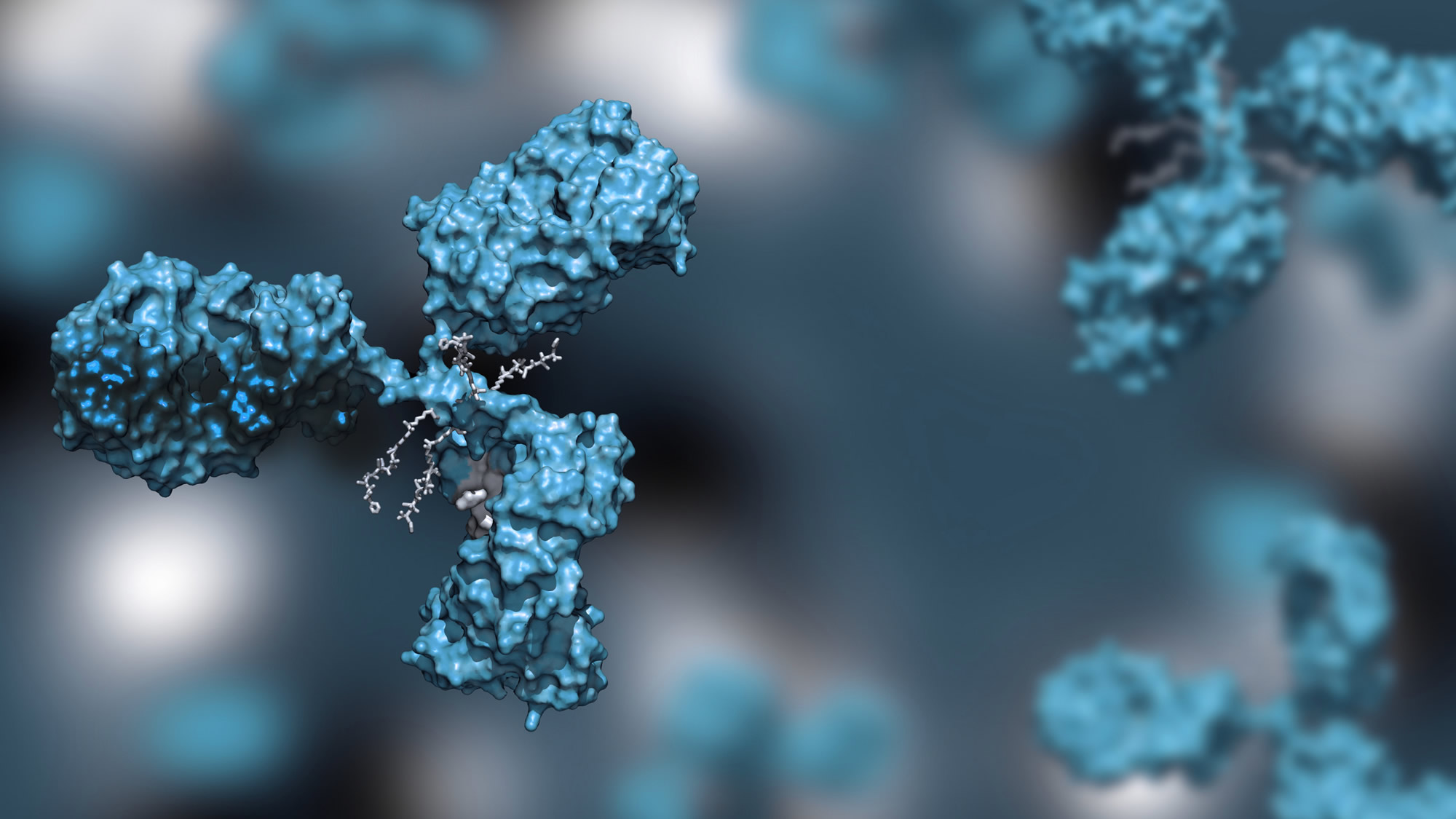
HDX-MS Epitope Mapping
Talk to Our Scientists
"*" indicates required fields
HDX-MS at CovalX
Defining where an antibody binds its antigen is a core requirement in therapeutic antibody development, biosimilar characterization, and mechanism-of-action studies. For programs that need actionable binding site data early, and under near-native conditions, HDX-MS provides a direct solution-phase answer.
HDX-MS Workflow
Step1. Initial Sample Testing
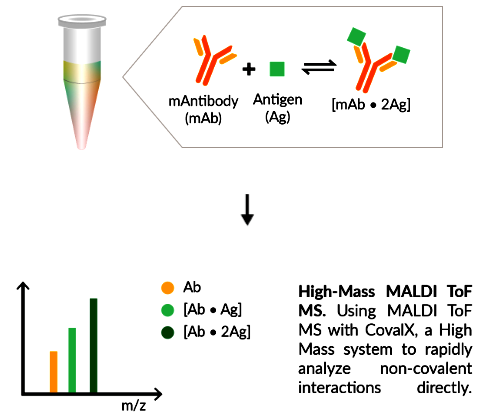
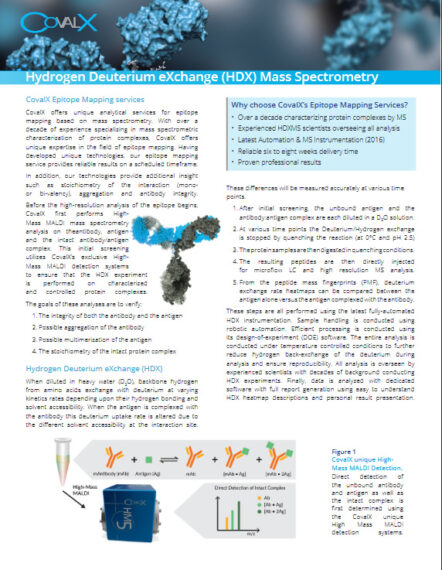
Before the high-resolution analysis of the epitope begins, CovalX first performs analysis on the intact proteins and protein complexes to study. The initial testing utilizes High-Mass MALDI MS analysis and is performed on the intact antibody, the intact antigen and the intact antibody/antigen complexe, directly in solution. The High-Mass MALDI MS analysis ensure that the HDX experiment is performed on characterized and controlled proteins and protein complexes. Understanding the stoichiometry and binding of the protein complexes to study is a key element of a successful epitope mapping study.
This analysis is unique to CovalX services. The goal is to verify:
- The integrity of both the antibody and the antigen
- The possible aggregation of the antibody
- The possible multimerization of the antigen
- The stoichiometry of the intact antibody/antigen complexes
Step2. Hydrogen Deuterium eXchange
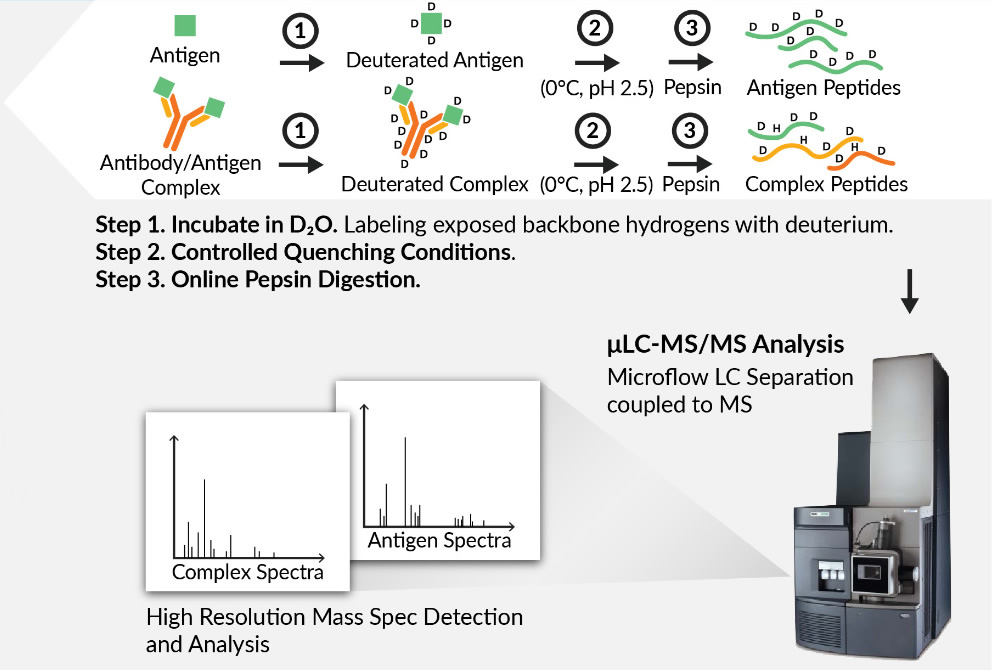
When diluted in heavy water (D2O), backbone hydrogens of amino acids exchange with deuterium at varying kinetics rates depending upon their hydrogen bonding and solvent accessibility. When the antigen is complexed with the antibody, this deuterium uptake rate is altered in the epitope regions. These differences can be measured accurately at various time points.
After initial screening, the unbound antigen and the antibody-antigen complex are diluted in a D2O solution.
At various time points, the Deuterium/Hydrogen exchange is quenched at 0°C and pH 2.5.
The protein samples are then digested into peptides using appropriate proteolytic digestion.
The resulting peptides are then directly injected for microflow LC-MS/MS detection.
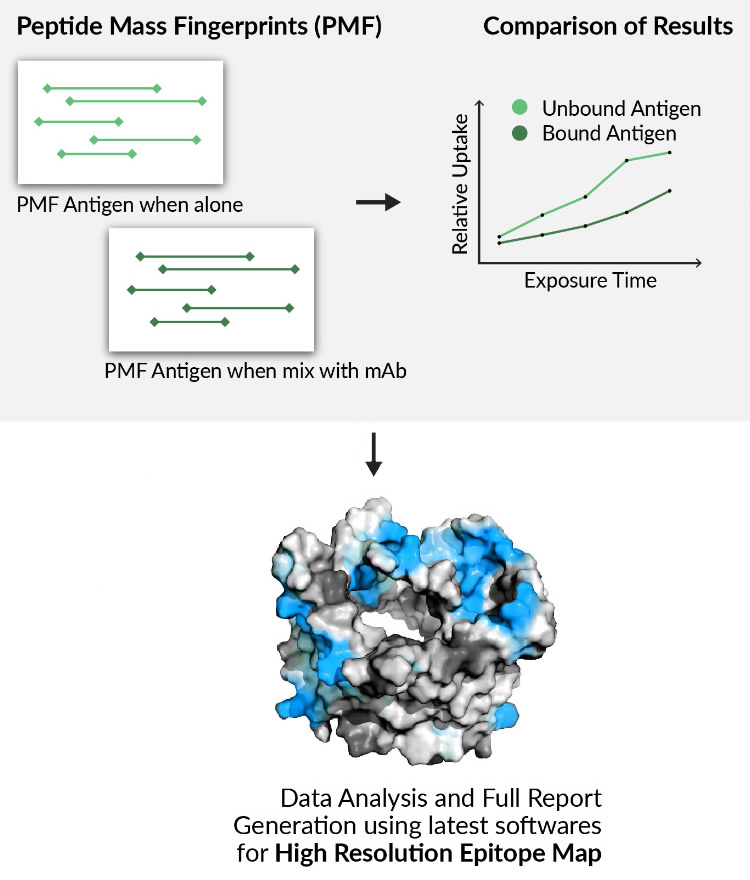
From the peptide mass fingerprints (PMF), deuterium exchange rate heat maps can be compared between the antigen alone or the antigen with antibody binding.
Step3. Data Analysis and Report
Finally, data is analysed using the latest software packages with full report generation using easy to understand HDX heat map descriptions and personal result presentation.
Want to know more?
Our team will help you design your experiment
HDX-MS Deliverables and Report Structure
| Intact complex QC data | High-Mass MALDI MS spectra confirming antibody and antigen integrity, aggregation and multimerization analysis, non-covalent complex formation and stoichiometry prior to the HDX experiment. Delivered as part of the project report. |
|---|---|
| HDX-MS protection map | A residue-level differential deuterium incorporation map comparing the free antigen and the antibody-antigen complex. Regions with statistically significant protection are identified and annotated across the full antigen sequence, with coverage reported explicitly so the boundaries of the interpretable data are clear. |
| Peptide-level deuterium kinetics | For each peptide detected in the map, multi-timepoint deuterium uptake plots showing the exchange kinetics in both conditions. This allows assessment of the protection magnitude and dynamics, not just the presence or absence of a signal. |
| Butterfly plots and heat maps | Standardized visualizations of the differential HDX-MS data: butterfly plots showing per-peptide deuterium differences across the antigen sequence, and heat maps for rapid visual identification of protected regions. Both formats are suitable for inclusion in regulatory submissions and internal reports. |
| Full analytical report | Written report covering materials and methods, instrumentation parameters, peptide map coverage, deuterium incorporation data, statistical significance thresholds applied, and interpretation of protected regions. Structured for direct use in IND, BLA, or biosimilar dossiers. |
Why choose HDX-MS by CovalX?
Intact complex verification before any labelling begins
Every project starts with the analysis of the free proteins and the assembled antibody-antigen complex. This step confirms antibody integrity, antigen homogeneity, complex stoichiometry, and absence of microaggregation before deuterium labelling begins. HDX-MS data generated on an incomplete or heterogeneous sample is uninterpretable; this upfront QC is systematic at CovalX and not standard practice at most CROs.
Linear and conformational epitopes in a single experiment
The protection signal in HDX-MS depends on the three-dimensional binding interface, not primary sequence. This means discontinuous conformational epitopes, where the binding surface is assembled from non-contiguous segments, are resolved with the same workflow as linear ones. Peptide array and mutagenesis-based approaches cannot make this claim.
Allosteric changes are captured alongside direct contacts
Because HDX-MS reports on solvent exposure across the full antigen sequence, conformational rearrangements induced by antibody binding are detected in the same dataset as direct contact regions. This is relevant for targets where the functional consequence of binding extends beyond the contact interface.
Resolution down to 1 to 5 amino acids
Spatial resolution depends on pepsin peptide map coverage of the antigen. CovalX runs a dedicated peptide mapping optimization step at project initiation to characterize coverage before the HDX-MS experiment begins, ensuring the final map reflects the actual resolution achievable for your specific antigen.
Automated robotics and high-resolution instrumentation
Sample handling for our HDX-MS experiments is conducted using the latest automation robotics, ensuring reproducibility across time points and conditions.
Direct access to scientists with over two decades of experience on HDX-MS analysis programs
Projects are handled by scientists with specific expertise in HDX-MS.
You have an epitope to map?
Contact us to scope your HDX-MS mapping project.
Technical Notes
Key parameters: resolution of one to five amino acids depending on peptide map coverage; sample requirements of approximately 300 ug of antigen and 250 ug of antibody per project; standard delivery within three/four weeks, with expedited timelines available on request.
Sequence coverage of the antigen is the primary determinant of mapping resolution. Coverage depends on pepsin digestion efficiency, which varies with antigen structure. Projects begin with a peptide mapping step to characterize coverage before the full HDX experiment. Buffer composition, detergent compatibility, and complex stoichiometry are discussed at project setup.
Regulatory Context
Epitope characterization data generated by HDX-MS is submitted as part of IND and BLA packages in support of mechanism-of-action documentation, biosimilar comparability dossiers, and antibody selection rationale. The method operates under near-native conditions, produces solution-phase data, and generates peptide-level resolution maps that can be directly referenced in regulatory submissions. HDX-MS is accepted as astructural characterization method by FDA and EMA.
FAQ
How long does an HDX-MS epitope mapping project take?
Standard projects are delivered within three to four weeks from sample receipt. Expedited timelines are available on request.
How much sample is required for HDX-MS epitope mapping?
CovalX requires approximately 300 µg of antigen and 250 µg of antibody per project. Sample requirements and buffer compatibility are confirmed at project setup.
Can HDX-MS map conformational epitopes?
Yes. HDX-MS resolves both linear and discontinuous conformational epitopes. The deuterium protection signal depends on the three-dimensional binding interface, not primary sequence, which makes it applicable to epitopes assembled from non-contiguous segments of the antigen.
What deliverables are included in a CovalX HDX-MS project?
Each project includes: High-Mass MALDI MS QC data on the intact proteins and complexes, a residue-level HDX protection map, per-peptide deuterium kinetics plots, butterfly plots and heat maps, and a full written analytical report structured for regulatory use.
Is HDX-MS data accepted in regulatory submissions?
Yes. HDX-MS epitope characterization data is accepted by FDA and EMA as structural characterization evidence in IND, BLA, and biosimilar comparability dossiers.
What is included in the pre-HDX quality control step?
Before deuterium labeling begins, CovalX performs High-Mass MALDI MS analysis to confirm antibody integrity, antigen homogeneity, absence of aggregation/multimerization, and stoichiometry of the antibody-antigen complex. This step is systematic at CovalX and specific to our workflow.
Can HDX-MS be combined with other epitope mapping methods?
Yes. HDX-MS can be run in parallel with XL-MS epitope mapping within the same project at CovalX. XL-MS provides residue-to-residue distance constraints complementary to the protection-based readout of HDX-MS, and both methods share the same initial sample QC step.
One CRO, Coordinated Data
HDX-MS epitope mapping at CovalX is integrated with the broader MS-based characterization portfolio. Intact complex analysis by High-Mass MALDI is performed at project initiation. For programs requiring orthogonal binding site data, HDX-MS can be run in parallel with XL-MS epitope mapping, which provides epitope-paratope distance-constraint data complementary to the protection-based HDX readout.
Running both methods through a single CRO reduces sample handling steps, allows coordinated experimental design across techniques, and consolidates reporting into a single deliverable.
Other Services that CovalX HDX-MS provide
| Biosimilar characterization |
| Higher-order structure |
| Conformational/Protein dynamics |
| Small molecules interaction (Compound binding analysis) |
| Protein-Protein interactions |
| Protein folding characterization |
Download supporting materials
 Hydrogen Deuterium eXchange Mass Spectrometry Services (HDX-MS)
For example patents, publications, or comparison data please see our library or contact us directly.
An overview of epitope mapping technologies can be seen here.