Surface Plasmon Resonance (SPR)
Talk to Our Scientists
"*" indicates required fields
Surface Plasmon Resonance (SPR) offers high-throughput, real-time, label-free affinity and kinetic characterizations on a range of sample types including monoclonal antibodies, proteins, and small molecules.
SPR measures these interactions directly, in real time, without labeling either binding partner. CovalX runs SPR alongside its mass spectrometry based characterization portfolio, providing label-free affinity and kinetic ranking across monoclonal antibodies, proteins, and small molecules.
How SPR Works
SPR measures binding at a sensor surface rather than in bulk solution. One binding partner, the ligand, is immobilized on a thin metal sensor chip; the other, the analyte, flows across it under microfluidic control. When the analyte binds, the mass accumulating at the surface raises the local refractive index, and the instrument tracks this change in real time as a shift in resonance units (RU). The response is proportional to the mass bound at the surface, which is why binding is reported directly without a label on either molecule.
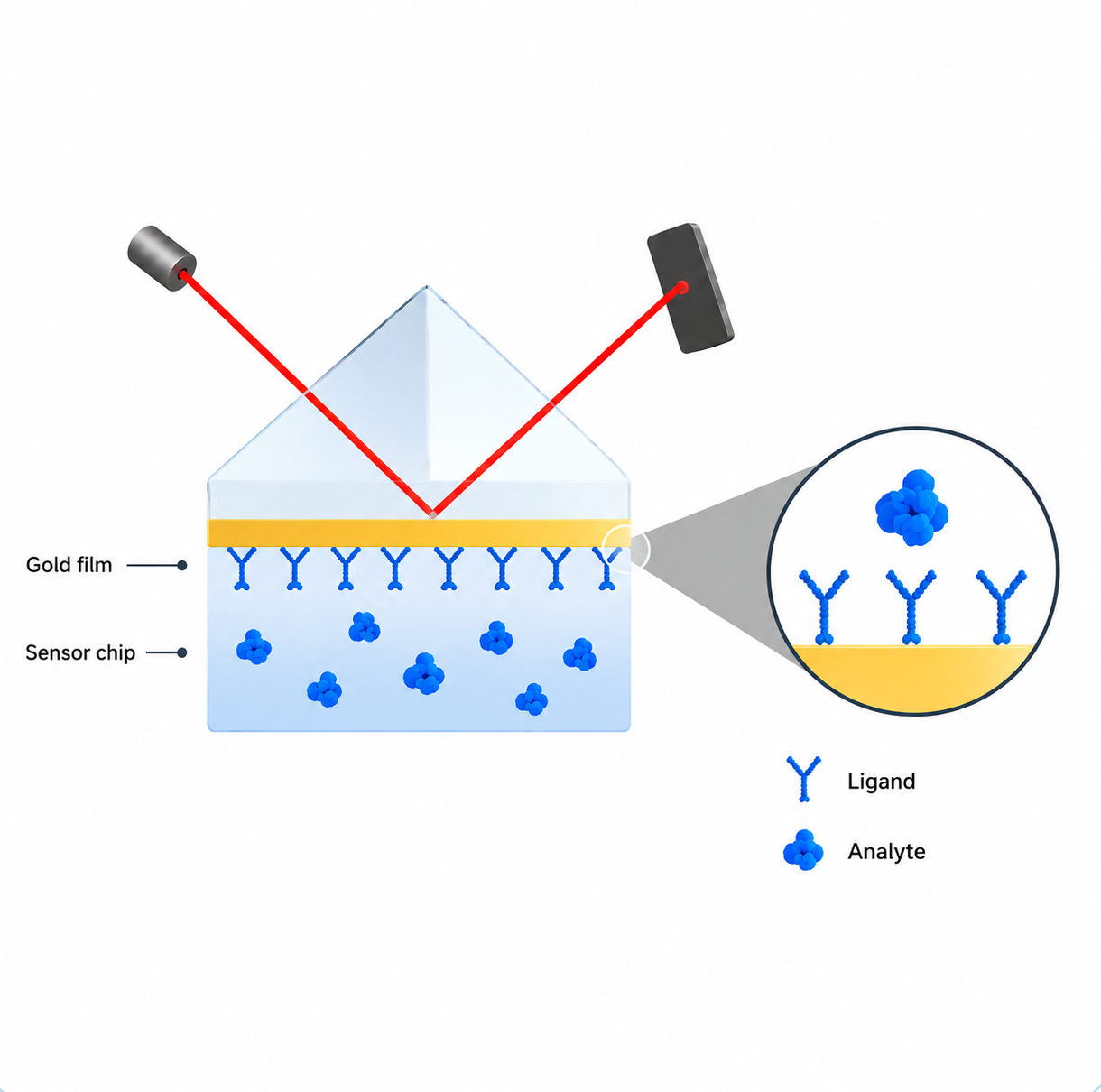
Because the signal scales with surface mass, a fixed number of bound molecules produces a lower response for a small molecule than for a protein, a factor that informs assay design for low-molecular-weight analytes. Running the same interaction across a series of concentrations produces a set of sensorgrams, each resolving an association phase during injection and a dissociation phase once buffer flow resumes. On-rate (ka), off-rate (kd), and equilibrium dissociation constant (KD) are calculated from this series by standard kinetic fitting.
Want to know more?
Our team will help you design your experiment
SPR applications
Drug discovery and antibody screening.
Epitope binning by SPR groups monoclonal antibodies according to shared or distinct binding sites on the same antigen, ahead of higher-resolution epitope mapping. Antibody screening is performed against unlabeled antigen in solution, avoiding artifacts introduced by label-dependent assay formats. Fragment screening, concentration analysis, and immunogenicity assessment are run on the same platform.
Lead optimization and kinetic ranking.
The residence time of a lead compound on its target, set by the off-rate, determines how long target engagement is maintained. SPR binding kinetics support candidate selection on the basis of target binding and target selectivity, ahead of the functional assays that follow. Candidates retained after kinetic ranking can move to HDX-MS for residue-level resolution of the binding interface.
Target and compound characterization.
Membrane-bound targets remain a persistent bottleneck for interaction analysis, since many methods require extraction from the native lipid environment. SPR measures these interactions directly, providing rapid characterization of compound-target binding when hundreds of candidates need to be triaged before optimization begins.
Comparability and biosimilarity.
Kinetic and affinity profiles generated by SPR serve as a functional fingerprint for comparing production batches, process changes, or innovator/biosimilar pairs, complementing the structural and mass-based comparability data generated elsewhere in the portfolio.
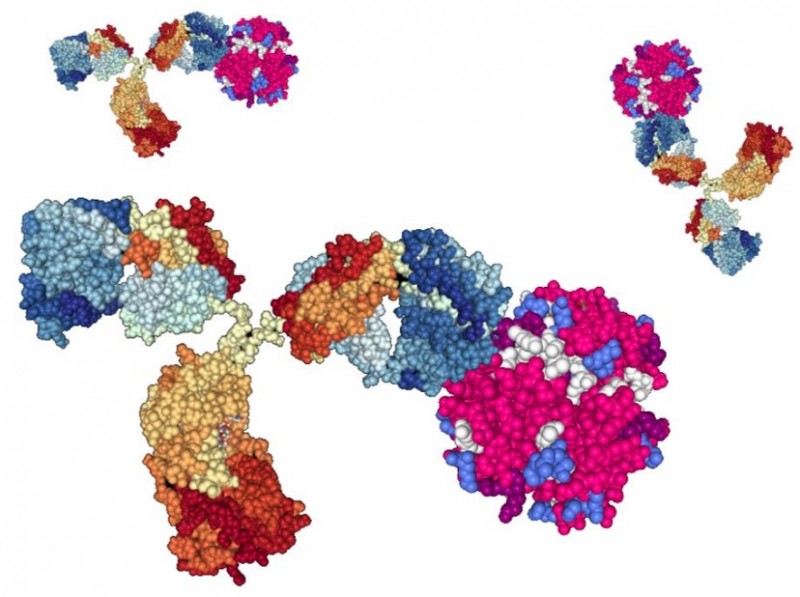 7 mAb protein interaction CovalX provides SPR analysis services to measure binding kinetics, affinity constants, and protein-protein interactions for biologics and drug discovery.
 SPR deliverables and report structure
| Sensorgram data | For each interaction tested, showing association and dissociation phases across the analyte concentration series used |
|---|---|
| Kinetic and affinity constants | On-rate (ka), off-rate (kd), and equilibrium dissociation constant (KD), calculated from the concentration series by standard kinetic fitting models. |
| Full analytical report | Covering materials and methods, instrumentation parameters, fitting model selection, and interpretation of the binding data |
Planning an SPR study?
Our scientists will help you design the right assay for your target
Technical notes
CovalX runs SPR analysis on current-generation instrumentation (paired with software for kinetic model fitting. Key parameters:
- Sample consumption: only 75 µg of each protein is required.
- Affinity range: fM to mM binding.
- Dissociation rate constant (kd): 10⁻⁵ to 1 s⁻¹.
- Sample type: small-molecule drug candidates to high-molecular-weight proteins, including DNA, RNA, polysaccharides, lipids, cells, and viruses, in buffer environments such as DMSO-containing buffers, plasma, and serum.
- Compared with biolayer interferometry (BLI), SPR provides higher accuracy at lower sample consumption.
Every SPR project begins with intact mass spectrometric characterization of the protein by High-Mass MALDI MS, confirming integrity and homogeneity before the interaction experiment. This upfront QC step is part of the standard CovalX workflow.
Buffer composition and sample compatibility are discussed at project setup.
Regulatory Context
Binding kinetics and affinity data generated by SPR support the biological activity and comparability sections of IND, BLA, and biosimilar dossiers, complementing the physicochemical characterization generated by structural and mass spectrometry based methods.
Frequently Asked Questions
What does SPR measure?
SPR measures the real-time binding interaction between two molecules by detecting refractive index changes at a sensor surface as one binding partner flows across the immobilized other. It yields on-rate, off-rate, and equilibrium dissociation constant without requiring a label on either molecule.
What sample quantity is required?
Standard projects require 75 µg of each binding protein. Sample type ranges from small molecules to high-molecular-weight proteins.
How does SPR differ from biolayer interferometry (BLI)?
SPR and BLI are related label-free interaction techniques. SPR provides higher accuracy and requires lower sample consumption than BLI for comparable interaction measurements. Both techniques are complementary and can be used in an orthogonal study.
What deliverables are included in an SPR project?
Clients receive sensorgram data, calculated kinetic and affinity constants, and a full written analytical report.
How does SPR relate to CovalX's epitope mapping services?
SPR provides kinetic and affinity ranking, including epitope binning to group antibodies by shared binding sites. For residue-level or structural resolution of the binding interface, HDX-MS or XL-MS epitope mapping is run as a follow-up on the same candidates.
One CRO, Coordinated Data
SPR analysis at CovalX is integrated with the broader characterization portfolio. Initial intact protein screening by High-Mass MALDI MS precedes every SPR project, and candidates identified by kinetic ranking can move directly to HDX-MS or XL-MS epitope mapping for residue-level binding site resolution on the same sample submission.
Running these analyses through a single CRO reduces sample handling steps, keeps molecular context consistent across techniques, and consolidates reporting into a single deliverable.
 CovalX Surface Plasmon Resonance (SPR) Services Brochure