XL-MS Epitope Mapping
Talk to Our Scientists
"*" indicates required fields
XL-MS at CovalX
Cross-Linking Mass Spectrometry (XL-MS) characterizes both the epitope on the antigen and the paratope on the antibody from a single experiment. It is applicable to conformational and linear epitopes, places no restriction on antigen size or complexity, and is compatible with full mAbs, Fabs, and tagged or modified proteins. XL-MS provides that information by covalently capturing spatial proximity between residues directly in solution, at peptide-level resolution, without requiring crystallization or sequence engineering.
HDX-MS Workflow
Step1. Initial Sample Testing
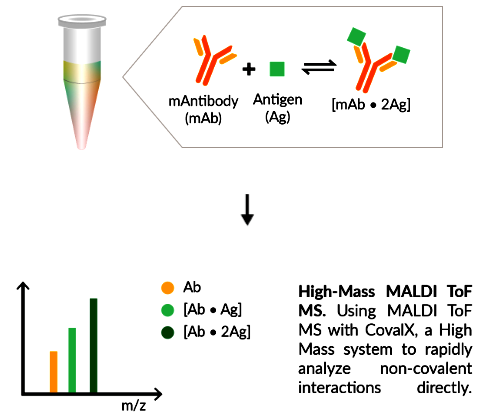
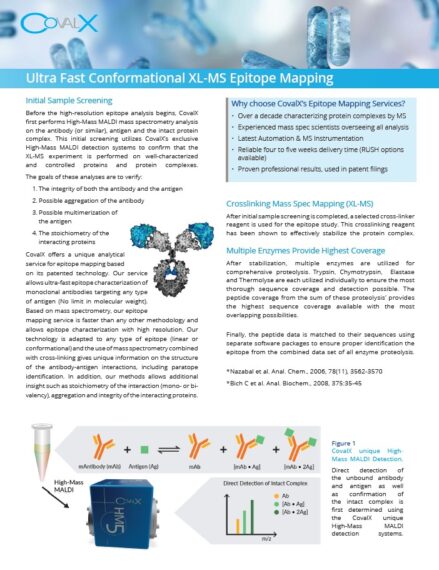
Before the high-resolution analysis of the epitope begins, CovalX first performs analysis on the intact proteins and protein complexes to study. The initial testing utilizes High-Mass MALDI MS analysis and is performed on the intact antibody, the intact antigen and the intact antibody/antigen complex, directly in solution. The High-Mass MALDI MS analysis ensure that the HDX experiment is performed on characterized and controlled proteins and protein complexes. Understanding the stoichiometry and binding of the protein complexes to study is a key element of a successful epitope mapping study.
This analysis is unique to CovalX services. The goal is to verify:
- The integrity of both the antibody and the antigen
- The possible aggregation of the antibody
- The possible multimerization of the antigen
- The stoichiometry of the intact antibody/antigen complexes
Step2. Crosslinking Mass Spec Mapping
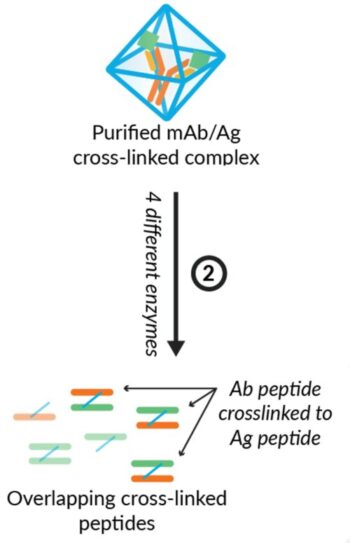
After initial sample screening is completed, an individual length of cross-linker is selected which is shown to effectively stabilize the complex using our high mass MALDI detection. A 50:50 mixture of deuterated to undeuterated cross-linker is created to provide a unique mass tag for detecting the linkers location within the proteins sequence. CovalX uses unique data analysis to later detect these deuterated cross-linkers directly, allowing the highest degree of confidence in the data.
Step3. Multiple Enzymes Provide Highest Coverage
After stabilization, four different enzymes are utilized in parallel for four separate and comprehensive digestions.. The peptide coverage from the sum of these digestions provides the highest sequence coverage available with the most overlapping possibilities.
Finally, the peptide data is matched to the sequences using dedicated software to ensure proper identification of the epitope and information on the paratope from one data set.
Discuss your XL-MS project with our team
CovalX scientists evaluate your project with you.
XL-MS Deliverables and Report Structure
| Intact complex QC data | High-Mass MALDI MS spectra confirming antibody and antigen integrity, aggregation and multimerization analysis, non-covalent complex formation and stoichiometry prior to the HDX experiment. Delivered as part of the project report. |
|---|---|
| Epitope map | A residue-level contact map identifying crosslinked pairs between antigen and antibody peptides. Annotated across the full antigen sequences, with sequence coverage reported explicitly so the resolution boundaries of the data are clear. The epitope map is also giving insight into the paratope counterpart. |
| Distance-constraint list | For each identified crosslinked peptide pair, the corresponding residue assignments and mass spectral data. This supports direct integration into structural modelling workflows or PDB annotation |
| Full analytical report | Written report covering materials and methods, instrumentation parameters, crosslinker chemistry, sequence coverage per enzyme, identified crosslinks, and interpretation of binding interface. Structured for direct use in IND, BLA, or biosimilar dossiers. |
Why choose XL-MS by CovalX?
Intact complex verification before mapping begins
Every project starts with High-Mass MALDI MS analysis of the free proteins and the assembled complex. Crosslinking data generated on a heterogeneous or incorrectly assembled sample is uninterpretable. This upfront QC step is systematic at CovalX and not standard practice at most CROs.
Isotopic verification of every crosslink
The D0/D12 DSS isotope mixture means every reported crosslink carries a mass-based confirmation built into the experiment. This provides the highest degree of confidence in the data. CovalX uses dedicated software optimized for detecting this isotopic signature.
No size restriction on the antigen
XL-MS places no upper limit on antigen molecular weight or complexity. The method is compatible with multimeric antigens, hydrophobic proteins, VLPs, full-length mAbs, Fabs, tagged and modified constructs.
Patented technology and over two decades of experience
CovalX’s XL-MS epitope mapping service is based on patented technology. Projects are handled by scientists with over two decades of experience in crosslinking mass spectrometry and protein interaction analysis.
YOU HAVE AN EPITOPE TO MAP?
Contact us to scope your XL-MS mapping project.
Technical Notes
Sample requirements: 200 µg of antigen and 200 µg of antibody per epitope.
Resolution: down to 1 to 5 amino acids, dependent on sequence coverage achieved by multi-enzyme digestion.
Compatible with full mAbs, Fabs, bispecific antibodies, tagged proteins, and modified constructs. No molecular weight limit on the antigen.
Buffer composition and crosslinking conditions are discussed at project setup. Primary amine-containing buffers compete with the crosslinker and must be replaced with compatible alternatives prior to the reaction.
Instrumentation: High-Mass MALDI MS for intact complex QC, high-resolution nLC-MS/MS for crosslinked peptide identification;.
Regulatory Context
Epitope characterization data generated by XL-MS is submitted as structural evidence in IND and BLA packages, supporting mechanism-of-action documentation, antibody selection rationale, and biosimilar comparability dossiers. XL-MS provides distance-constraint data that complements and structurally contextualizes protection-based mapping methods such as HDX-MS. Both FDA and EMA accept MS-based structural characterization data in regulatory submissions. Because the method operates under near-native solution conditions and does not require sample immobilization or sequence modification, the data reflects the biologically relevant binding interface.
FAQ
How long does an XL-MS epitope mapping project take?
Standard delivery is three to four weeks for a single epitope. Projects covering up to five epitopes against the same antigen are delivered within five weeks. Expedited timelines are available on request.
What are the sample requirements for XL-MS epitope mapping?
200 µg of antigen and 200 µg of antibody per epitope. Buffer must be free of primary amines; PBS and HEPES are compatible. Sample purity and buffer compatibility are discussed at project setup.
Can XL-MS map conformational epitopes?
Yes. XL-MS resolves both linear and conformational epitopes. The crosslinking reaction captures spatial proximity at the three-dimensional binding interface, making it applicable to discontinuous epitopes assembled from non-contiguous segments of the antigen.
What deliverables are included in a CovalX XL-MS project?
Each project includes: High-Mass MALDI MS QC data on the intact proteins and complexes, an epitope paratope indication contact map with residue-pair distance constraints, per-crosslink mass spectral confirmation via the D0/D12 isotopic doublet, and a full written analytical report structured for regulatory use.
Is XL-MS accepted in IND and BLA submissions?
Yes. MS-based structural characterization data, including crosslinking data, is accepted by FDA and EMA in IND and BLA submissions as supporting evidence for mechanism of action, antibody selection, and biosimilar comparability. The analytical report is structured for direct inclusion in regulatory dossiers.
What is included in the pre-XL quality control step?
Before crosslinking begins, CovalX performs High-Mass MALDI MS analysis to confirm antibody integrity, antigen homogeneity, absence of aggregation/multimerization, and stoichiometry of the antibody-antigen complex. This step is systematic at CovalX and specific to our workflow.
Can XL-MS be combined with other epitope mapping methods?
Yes. XL-MS can be run in parallel with HDX-MS epitope mapping within the same project at CovalX. HDX-MS provides a protection-based view of the epitope under solution-phase conditions; XL-MS provides explicit residue-pair distance constraints and simultaneous paratope identification. Both methods share the same initial sample QC step.
One CRO, Coordinated Data
XL-MS epitope mapping at CovalX is integrated with the broader MS-based characterization portfolio. Intact complex analysis by High-Mass MALDI is performed at project initiation for every project. For programs requiring orthogonal binding site data, XL-MS can be run in parallel with HDX-MS epitope mapping: XL-MS provides residue-pair distance constraints and paratope identification, while HDX-MS provides a protection-based view of the epitope under solution-phase conditions. The two readouts are complementary and address different aspects of the binding interface.
Talk to Our Scientists
Our team is available to answer any of your questions about our products and services
Other Services that CovalX provides
| Biosimilar characterization |
| Higher-order structure |
| Conformational/Protein dynamics |
| Small molecules interaction (Compound binding analysis) |
| Protein-Protein interactions |
| Protein folding characterization |
Download supporting materials
 CovalX Crosslinking Mass Spec Mapping (XL-MS) Brochure
For example patents, publications, or comparison data please see our library or contact us directly.
An overview of epitope mapping technologies can be seen here.